
Start with the free steps, then grab bars, then stair rails. Those three cover most of what CDC lists for the home and cost well under $2,000 even with professional labor. A ramp or stair lift only enters the plan when the stairs or entry have become the actual problem, and they cost more than everything else combined.
Disclosure: this page has no affiliate links and earns nothing from your clicks.
Prices on this page are national ranges read between 2025 and 2026 (dates below). They are not quotes. Your zip code, wall type and contractor will move them.
How the planner spends your budget
It walks a fixed list in priority order, adds up the low end of each cost, and funds an item only if the running low total still fits. Anything after that goes on a "defer" list with its price range. If the high end of the funded items would pass your budget, the line carries a flag, because a range is a range.
The order comes from CDC's page on preventing falls. It lists the home steps: clear things you could trip over, add grab bars inside and outside the tub or shower and next to the toilet, put railings on both sides of stairs, and add lighting with brighter bulbs. The same page puts medicine review, yearly eye checks and leg-strength and balance exercise on the list, and tells people to talk to a doctor about their fall risk (CDC, read 2026-11-01). None of those need a contractor, and several cost nothing.
The ranking beyond that is our judgment: cheap items that match a CDC step come first, expensive structural work comes last. CDC does not rank the steps and we found no source that does. No source we opened prices lighting or bathroom fixtures such as a taller toilet, so the planner lists lighting as a free step and leaves those fixtures unpriced.
$500 covers the free steps and two grab bars
At $500, you do the free items properly and install grab bars. Walk each room and move cords, loose rugs and clutter. Book the eye exam. Ask a pharmacist whether any medicine the person takes can cause dizziness or drowsiness, as CDC suggests.
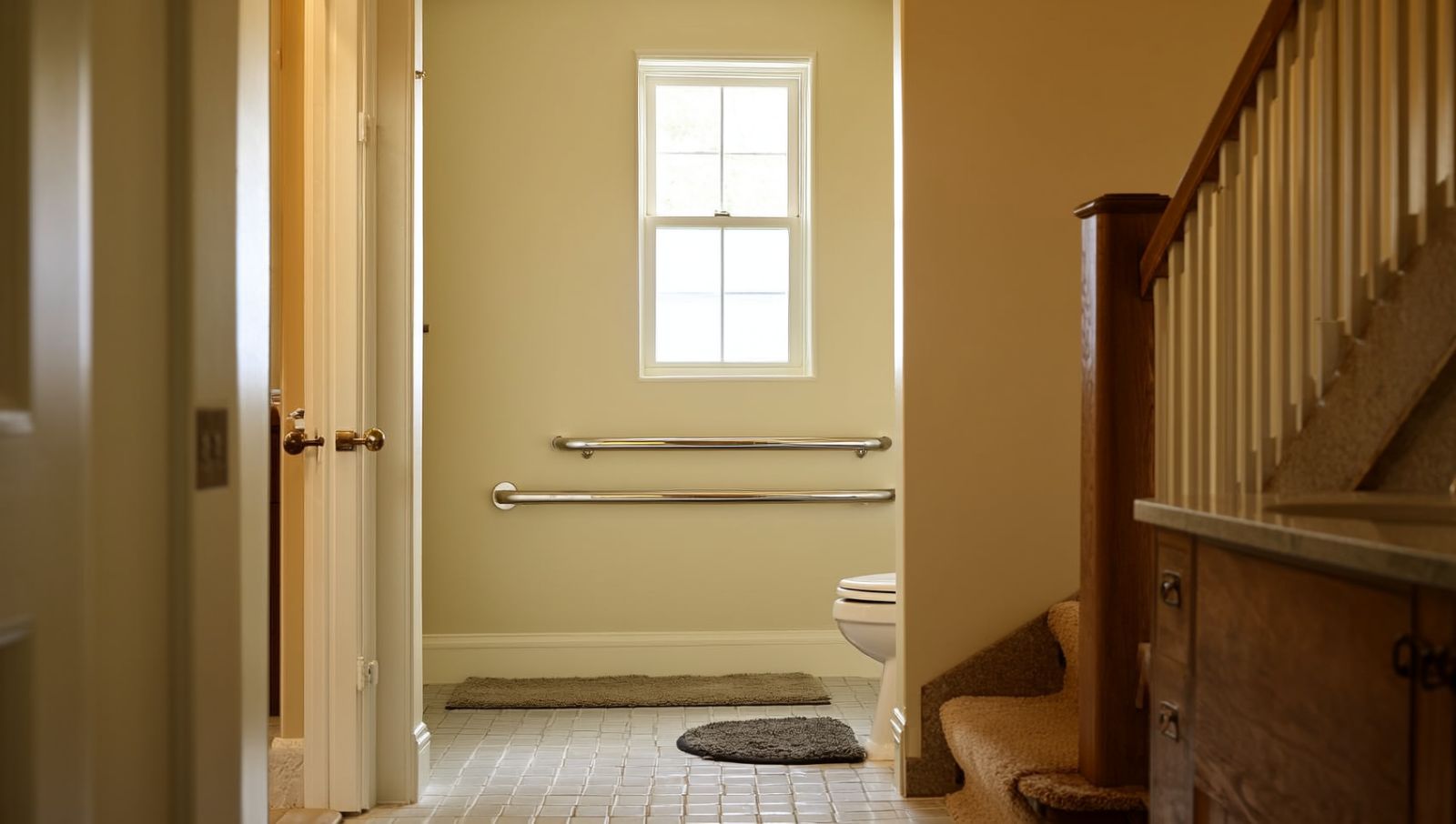
Then the bathroom. The planner counts two bars for a tub or shower and one for the toilet. Angi's published range for professional installation is $200 to $350 per bar, and $30 to $100 per bar in materials if you do it yourself. We could only read that range in Angi's search listing, because the page itself blocked our request, so treat it as a listing figure and confirm it locally. Three professionally installed bars land at about $600 to $1,050, which is over a $500 budget, so the planner funds two and defers one. Three DIY bars cost roughly $90 to $300.
Bars only help if they hold a person's weight. If you are unsure about the wall behind a tile shower, pay for the install on that one. We did not find a primary source on wall blocking or stud placement, so we give no instructions for it.
$2,500 adds stair rails on both sides
Rails come next because stairs are where one slip becomes a serious fall, and CDC calls for rails on both sides. Homewyse's May 2026 national average for installing a stairway handrail runs $40.15 to $60.18 per linear foot (Homewyse, read 2026-11-01). A 14-foot run, one side of a typical flight, is therefore roughly $560 to $840 ($562 to $843 exactly). Measure each missing side along the slope, not the floor.
With three bars and one rail, the planner totals about $1,150 to $1,900 ($1,162 to $1,893). That leaves some room, but not enough for a stair lift. A straight lift starts at about $2,000 even at the low end.
$10,000 is where a ramp or stair lift belongs in the plan
Add these only if you tick the box that says the steps are now the barrier. A person who can still climb safely with two good rails does not need a lift yet.
Fixr gives $1,700 to $5,000 for a wheelchair ramp nationally, about $3,000 on average, and says outdoor ramps run $1,200 to $5,000 and indoor ones $200 to $2,000 (updated 2025-01-31, Fixr ramps). Fixr's stair lift page puts a straight lift at $2,000 to $8,000 installed and a curved one at $8,000 to $20,000 (updated 2025-01-31, Fixr stair lifts). The spread is wide because the real quote depends on staircase length and the model.
Even at $10,000, the planner flags the ramp and lift because their high ends can overrun the budget. Collect two or three written quotes before committing.
What the planner leaves out
It does not diagnose anything. It will not tell you whether a particular person needs a lift, and it prices no bathroom changes beyond grab bars. If balance, vision or medicines are part of the problem, a doctor deals with that; hardware alone does not. The planner gives estimates from the numbers you enter and is not medical, legal or financial advice.
Costs above come from Fixr (ramps and stair lifts), Homewyse (handrails) and Angi (grab bars, via its search listing). They are secondary cost guides, not government data, and their methods are not fully published. That is why every line is a range and every line carries a date.