
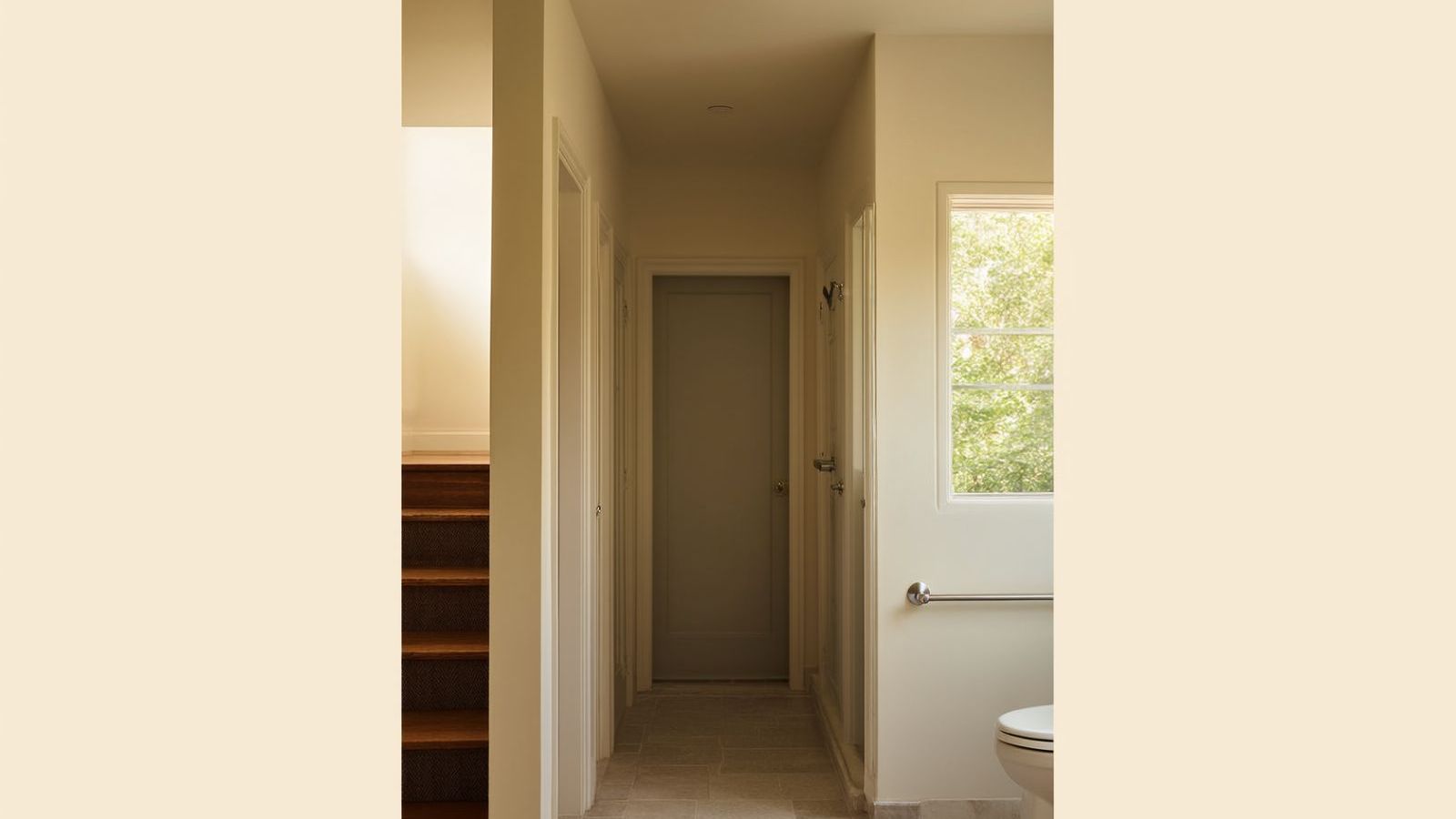
Add grab bars first, then check whether the toilet is too low, then widen the door only if a walker or wheelchair cannot get through it. Take on a curbless shower when the shower is being rebuilt anyway, because it is the most expensive of the three. No source we found measures falls prevented per dollar for any of these, so the order below rests on what CDC lists and on what each change costs.
Disclosure: this page has no affiliate links and earns nothing from your clicks.
Prices are national ranges from the guides named below, with the date each was read. They are not quotes.
What the evidence does and does not rank
CDC says more than 1 in 4 adults 65 and older falls each year, and that falling once roughly doubles the chance of falling again (CDC, updated 2026-09-04, read 2026-11-02). Its prevention page names grab bars "inside and outside your tub or shower and next to the toilet" as a home step. It does not mention toilet height, door width or curbless showers (CDC prevention page, read 2026-11-02).
So the grab bar is the only bathroom fix CDC itself recommends. The other three fixes below are reasonable accessibility changes, but we found no study in the sources we opened that ranks them against each other. Treat the ranking as judgment.
Comparison
| Fix | Typical cost | Disruption | Solves |
|---|---|---|---|
| Comfort-height toilet | Labor $150 to $440 (Fixr, Jan 2026); the toilet price is not published on that page | Half a day | Standing up and sitting down |
| Wider door | About $600 to $2,000 in a search listing for Angi; not confirmed on the page | Days, with drywall and paint | A walker or wheelchair that does not fit |
| Curbless shower | $6,000 average installed (Fixr, Mar 2025) | Days to weeks | Stepping over a tub wall or curb |
The toilet: cheap, and the height is specified
The ADA Standards set toilet seat height at 17 to 19 inches to the top of the seat (ADA 2010 Standards, section 604.4, read 2026-11-02). Fixr says taller toilets of this range usually cost more than standard 14.5 to 16 inch models, but gives no price for them. It puts labor for a toilet install at $150 to $440, and plumbers at $75 to $150 an hour, with hauling the old one away adding $50 to $200 if billed separately (Fixr, updated 2026-01-28).
The ADA figures apply to public and commercial buildings. A home has no such requirement, but the height range is a useful target if standing up is hard for the person in the house. A taller seat does not help a person whose legs are weak; a grab bar next to the toilet does, and CDC lists it.
The door: measure before you spend
The ADA requires 32 inches of clear width in a door opening, and 36 inches when the opening is deeper than 24 inches (ADA 2010 Standards, section 404.2.3, read 2026-11-02). Clear width is measured with the door open, so the door and its hinges take a couple of inches off the opening. Many older bathroom doors are 24 or 28 inches wide.
Measure the walker or wheelchair, not the standard. If it clears the door, skip this fix. If it does not, price it locally: a search listing for Angi shows $600 to $2,000 for widening a doorway, but Angi blocked our request for the page and we could not open HomeAdvisor either, so we cannot vouch for that range. Cost depends heavily on whether the wall carries load, which a contractor has to tell you.
The curbless shower: worth it mostly as part of a remodel
Fixr lists a curbless shower at $6,000 average installed, and says choosing curbless "doesn't usually add much" to the cost of a shower. Surround material swings the price: acrylic runs $2,000 to $5,000 and porcelain tile $7,000 to $14,000. Moving drain or supply lines adds $200 to $500, and permits $100 to $500 in most areas (Fixr, updated 2025-03-04). Other pages we saw in search results claim a bigger premium for curbless designs, but we did not open them.
For comparison, the ADA's standard roll-in shower is at least 30 inches wide by 60 inches deep inside, with a 60 inch roll-in entry (section 608.2.2). That is a public-building standard, but it shows how much floor space a wheelchair user needs.
If the shower works and the person can step in safely with grab bars, $6,000 is hard to justify as the first spend.
A sensible order on a limited budget
- Grab bars at the shower and toilet. Our grab bar placement guide and budget planner cover dimensions and installation costs.
- Toilet height, if standing up is the difficulty.
- Door width, only after measuring the mobility aid.
- Curbless shower, when the bathroom is being remodeled for other reasons or the tub wall is the barrier.
If balance, vision or medicine side effects are behind the falls, a doctor deals with that and hardware does not. This page is general information based on public cost guides and standards, not medical, legal or financial advice.
References checked
Sources were opened 2026-11-02, except where noted in the text. The cost guides are secondary sources whose methods are not fully published, which is why every figure is a range or an average with a date.